
79 neighborhoods, most of them built before 1940
Epoxy Flooring in St. Louis, MO
Coatings planned around old concrete, sticky July air and winters that still freeze the driveway.
- We measure your slab and run a moisture test during a free on-site estimate
- A written quote naming every prep step and coat, with the final price
- Surface prep explained before we grind a single square foot
Coating Floors in an Old Brick City
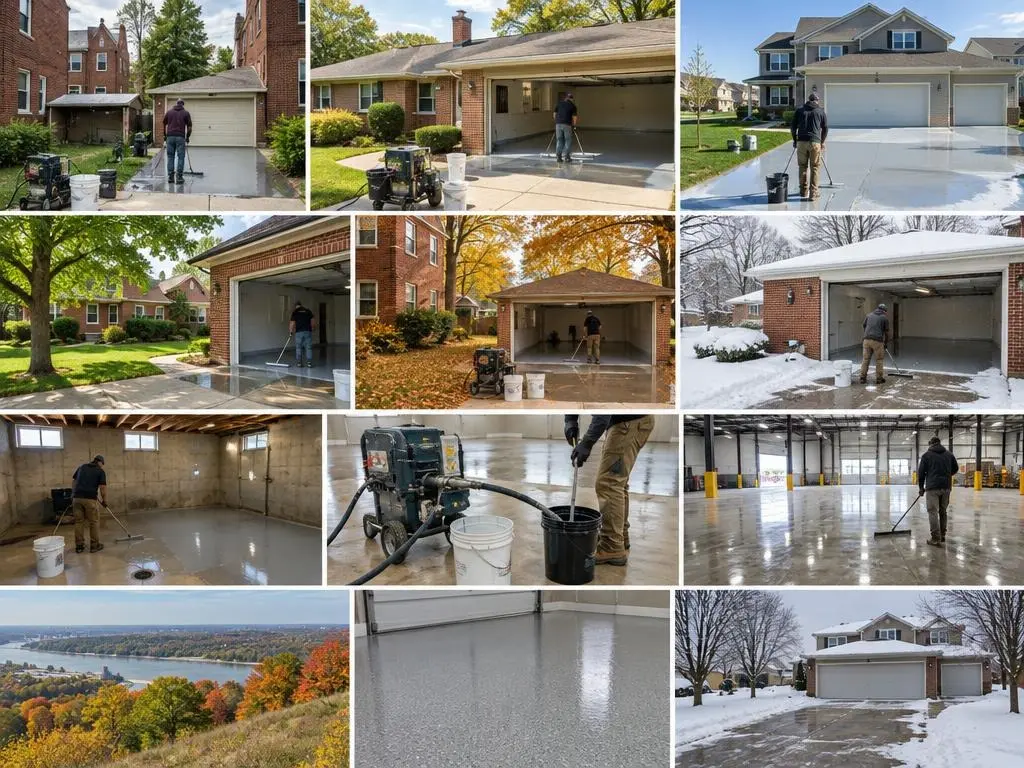
Epoxy flooring in St. Louis starts from the concrete the city already has, and most of it is old. Point2Homes' summary of ACS data shows 58.4% of city housing units dating from 1939 or before, with 1938 as the median year built. Garages behind those houses, basements under them and the warehouse floors that became lofts all carry decades of oil, paint and patching. We plan every epoxy floor coating around that history instead of pretending the slab is new.
What an older slab asks for
Concrete poured before the Second World War was rarely placed over a vapor barrier. Moisture can rise through it from below, and a coating that traps that moisture will lift. So the first visit always includes a moisture test. After that we look for:
- Old sealers and paint that must be ground off, not covered.
- Spalled or pitted areas that need filling before any primer.
- Settled sections where a crack has opened and shifted.
- Floor drains in alley garages that set the slope we have to respect.
Humidity is the other half of the job
St. Louis averages 69.7% relative humidity across the year, and the July dew point averages 66.6 F, per climate data on Wikipedia. Warm, wet air settling on a cool basement or garage floor can leave a film of condensation. Coatings applied over that film do not bond well. On muggy days we watch the gap between surface temperature and dew point and reschedule rather than force a pour.
Freeze, snow and road salt
The January mean low is 23.8 F and the city averages 16.6 inches of snow a year. Cars bring slush and de-icing salt into the garage all winter. A broadcast flake floor with a polyaspartic topcoat holds up to that salt and is easy to squeegee out. A thin roll-on paint, by contrast, tends to peel where tires sit.
Lofts, shops and the karst underneath
The Washington Avenue loft district grew out of factory and warehouse buildings converted starting in the late 1990s. Those floors are often thick and sound but stained and uneven. A ground and polished base with a clear or metallic epoxy can turn them into a finished surface. Parts of the city south of downtown also sit on karst, with sinkholes and caves, so we look closely at cracks there before we promise a smooth result.
Choosing among epoxy flooring companies
When you talk with epoxy flooring contractors in the city, ask each one how they will test for moisture, how deep they will grind, and what they will do about the cracks you already see. Those answers say more about how a floor will age than the color chart does. We put ours in writing.
St. Louis Conditions That Shape a Floor
- Pre-war housing stock. Housing from 1939 or before makes up 58.4% of units, and 1938 is the median construction year (ACS, via Point2Homes).
- Muggy summers. Average annual relative humidity is 69.7%, and the July dew point averages 66.6 F at the Lambert airport station.
- Real winters. January's mean daily low is 23.8 F, and snowfall averages 16.6 inches a year over 14.5 snowy days.
- Karst south of downtown. St. Louis limestone is the main surface rock, and areas south of downtown are karst with sinkholes and caves.
St. Louis Questions
My garage in St. Louis is about 90 years old. Can it still be coated?
Usually, yes. Age matters less than condition. We test for moisture, grind off whatever is on the surface and repair cracks and pits. When a slab is heaved or broken up badly, we will tell you replacing it makes more sense than coating it.
Why do you check the weather before an install day?
Because St. Louis summers are humid. If the floor is close to the dew point, moisture can condense on it and weaken the bond. Moving a job by a day is better than a floor that fails early.
Does road salt hurt an epoxy floor?
Salt is hard on bare concrete and on thin paints. A properly installed flake system with a polyaspartic topcoat resists it well. Rinsing or squeegeeing the salty slush out now and then keeps it looking good.
Can you coat a loft floor that used to be a factory?
Often. Old industrial slabs can be thick and solid. We grind them to open the surface, fill damage, and then apply a clear, solid or metallic system depending on the look you want.
Free Estimates in St. Louis, MO
Book a free visit and get a written quote for your St. Louis garage, basement, loft or shop.
Epoxy Flooring Near St. Louis
- Epoxy Flooring in Clayton, MO
- Epoxy Flooring in Ladue, MO
- Epoxy Flooring in Kirkwood, MO
- Epoxy Flooring in Webster Groves, MO
- Epoxy Flooring in Brentwood, MO
- Epoxy Flooring in Maplewood, MO
- Epoxy Flooring in Richmond Heights, MO
- Epoxy Flooring in University City, MO
- Epoxy Flooring in Creve Coeur, MO
- Epoxy Flooring in Chesterfield, MO
- Epoxy Flooring in Ballwin, MO
- Epoxy Flooring in Town and Country, MO
- Epoxy Flooring in Des Peres, MO
- Epoxy Flooring in Florissant, MO
- Epoxy Flooring in Manchester, MO
- Epoxy Flooring in Hazelwood, MO
- Epoxy Flooring in Maryland Heights, MO
- Epoxy Flooring in St. Charles, MO
- Epoxy Flooring in O'Fallon, MO
- Epoxy Flooring in Wentzville, MO
- Epoxy Flooring in Affton, MO
- Epoxy Flooring in Mehlville, MO
- Epoxy Flooring in Arnold, MO
- Epoxy Flooring in Fenton, MO